Sandy Loam Over Clay: Why Nacogdoches Homes Settle Unevenly
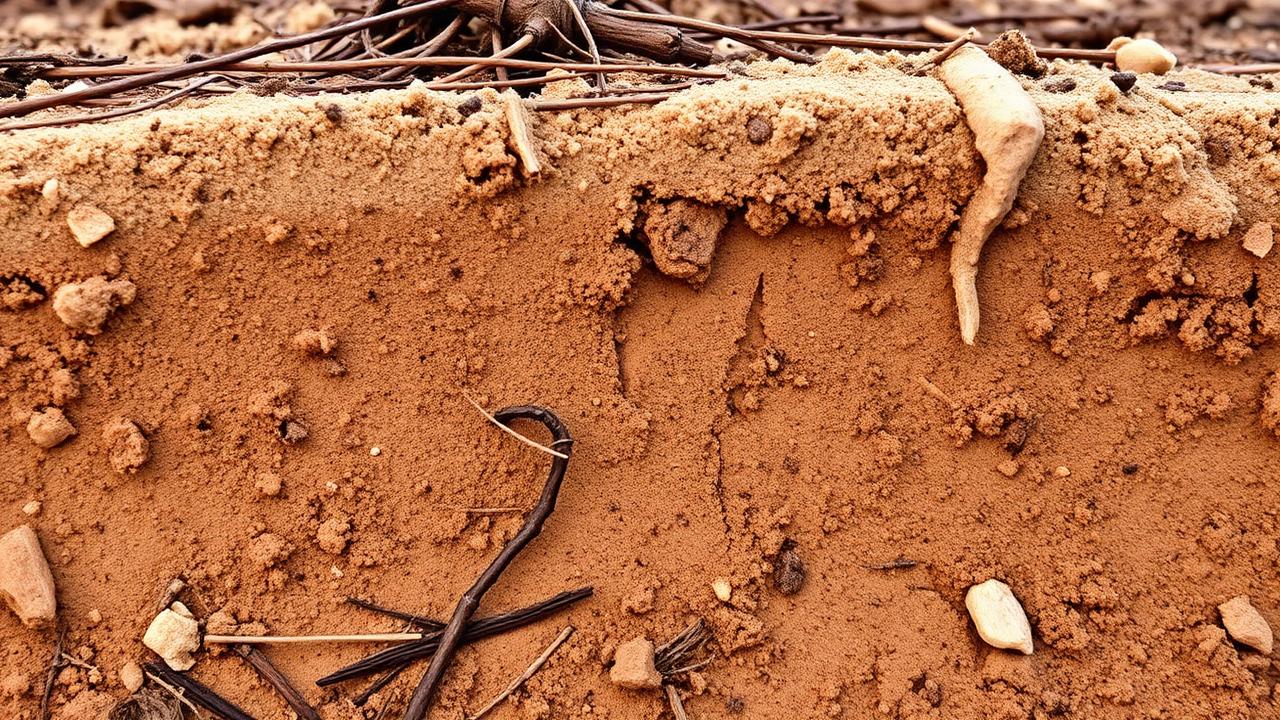
Here is the short answer. Nacogdoches County soils are typically a sandy loam topsoil sitting over a dense clay subsoil. Rainwater moves down through the sandy layer quickly, hits the clay, and stops, perching in the upper ground instead of draining away. Because that perched water collects unevenly, the soil under some piers softens while the soil under others stays firm, and the home settles unevenly rather than uniformly.
Understanding that one mechanism explains most of what manufactured homeowners in this area experience: the door that will not latch, the window that binds, the floor with a slope you can feel in socks.
The two layer soil profile of the piney woods
Dig into almost any lot around Nacogdoches and you meet the same sequence. On top, a sandy loam: loose, crumbly, easy to work, and quick to absorb water. Below it, a dense clay subsoil that is a different material entirely: tight, slow, and nearly waterproof by comparison.
Neither layer is a problem on its own. Sandy soils drain freely, and clay, once fully consolidated, can be a stable bearing material. The trouble is the boundary between them, and what water does when it gets there.
Why water perches instead of drains
Picture rain falling on a sandy lot. The water moves down through the loam fast, the way water moves through a pot of sandy soil in a garden bed. Then it reaches the clay, and its downward speed drops to nearly nothing. With nowhere to go, the water spreads sideways along the top of the clay layer and sits there, in what soil scientists call a perched water condition.
How long it sits depends on the lot. Slope, nearby trees, and the depth of the sandy layer all change the drainage picture. Two lots on the same street can behave differently, and, more importantly for a manufactured home, two ends of the same lot can behave differently.
How perched water produces uneven settling
A manufactured home does not rest on one continuous foundation. It rests on dozens of individual piers, each carrying its share of the frame on its own footing. Each pier is only as good as the soil directly beneath it.
Different piers, different soil conditions
When perched water collects under part of a home, the piers in that zone sit on softened soil. Their footings, sized for firm ground, slowly sink into ground that can no longer carry them. Piers a few feet away, over a drier pocket, hold their position. The frame is now supported at different heights, and it flexes to follow.
This is why settling in Nacogdoches County almost never announces itself as the whole home sinking evenly. It shows up as one corner, one end, or one side dropping, which is exactly the pattern that racks door frames, binds windows, and opens cracks where walls meet ceilings.
Seasonal swings make it worse
East Texas alternates between soaking stretches and genuine dry spells. In a wet season, perched water softens support under parts of the home. In a dry season, the clay shrinks as it dries and tree roots aggressively pull what moisture remains. A pier zone can cycle between soft and firm several times a year, and each cycle tends to ratchet the settling a little further rather than reversing it.
What this means for pier support
First, footing size matters more here than in free draining country. A pier pad that is adequate on firm ground may be undersized for soil that spends part of every year saturated. When piers are repaired or replaced, the footing conversation is the important one.
Second, releveling addresses the symptom (a frame out of level) but the ground keeps moving. Homes in this area benefit from periodic level checks, because catching a quarter inch of drift is a simpler job than catching two inches of it.
Third, water management around the home pays off. Gutters, grading, and keeping the skirting line drained reduce how much perched water forms under the home in the first place. It cannot change the soil profile, but it changes how much water reaches it.
This is not Blackland Prairie country
Homeowners who read about Texas foundation problems often run into advice written for the Blackland Prairie, the band of expansive clay that runs through the Dallas, Austin, and San Antonio corridor. That guidance assumes a single, deep clay soil that swells dramatically when wet and shrinks hard when dry, heaving foundations up and down as a unit.
Nacogdoches County works differently. The surface soil here is sandy and free draining, and the clay sits beneath it as a barrier. The problem is not the whole soil mass swelling and shrinking together; it is water stacking up on top of a buried clay layer in some spots and not others. Advice written for expansive prairie clay, whether about watering foundations or uniform heave, mostly does not apply to a pier and beam manufactured home on a piney woods lot.
What homeowners can watch for
Walk your home after a sustained wet period and again after a dry one. Look for doors that change behavior, new floor slopes, skirting that buckles or gaps, and gaps opening where porches or steps meet the home. Under the skirting line, note any spots where water stands after rain, and pay attention to whether the same corner of the home keeps showing symptoms, because a repeating location points to a ground condition rather than a random event.
When more than one symptom appears, or one symptom keeps returning after adjustment, it is time for a level check and a look at the piers. This site can connect you with an independent local contractor who works in these soils every week.